Yuhao LU
World models and robotics at RoboScience

Hi, I’m Yuhao Lu. At RoboScience, I study how world models can predict motion in 3D. In WorldFlow, we train a model to predict both future video frames and the 3D trajectories of points in a scene. 机器之心 featured this work.
I’m also exploring hierarchical models for robotic agents and the software harnesses that coordinate their policies. VEPH is my proposal for using verification to guide how an ensemble of robot policies evolves.
Previously, I worked on 3D scenes at Alibaba. For LayoutDSL, I designed a domain-specific language for arranging furniture, developed a policy that writes layout programs in that language, and built the training pipeline from supervised fine-tuning through reinforcement learning.
I also developed applications for scene reconstruction, image-layer inpainting, and 3D mesh retopology. I’m particularly familiar with VGGT for multi-view reconstruction and PolyGen for mesh generation. I built the end-to-end real-to-sim pipeline behind Taobao’s 放我家 feature, which shoppers have used about a million times to preview furniture in their homes.
I earned my master’s degree in the Department of Electronic Engineering at Tsinghua University, where Prof. Shengjin Wang advised me. My work on VL-Grasp studied how robots can grasp an object described in natural language. I earned my bachelor’s degree at Huazhong University of Science and Technology.
News
| Nov 20, 2026 | 机器之心 featured our work on WorldFlow. |
|---|---|
| Oct 29, 2026 | We released WorldFlow, a world model that jointly predicts future video and 3D motion. |
| Jul 31, 2026 | Our LayoutDSL paper is on arXiv. It studies how a language model can learn to arrange furniture using a domain-specific language. |
| Jun 2023 | VL-Grasp was accepted to IROS 2023. |
| Jun 2023 | Tsinghua University named me an Outstanding Master’s Graduate Student (top 2%) and awarded my thesis an Outstanding Master’s Thesis honor (top 5%). |
| Mar 2023 | I led the CV-AI team at the Intel Indoor Robot Learning Grand Challenge in Shanghai. We won first prize in the Recognition Track (few-shot detection) and second prize in the Manipulation Track (grasping and feeding). |
| Jun 2022 | We built RoboRefIt, a visual grounding dataset for robotics. |
| Feb 2022 | FGC-GraspNet was accepted to ICRA 2022. |
Selected Publications
-
WorldFlow: Joint Video and 3D Motion Prediction via Large-Scale Pretraining
arXiv preprint, 2026
* Equal contribution
WorldFlow predicts how a scene will look and how points in it will move in 3D. A single model learns both tasks from 1.44 million object-level samples spanning simulated and real-world interactions.
@misc{lu2026worldflow, title = {WorldFlow: Joint Video and 3D Motion Prediction via Large-Scale Pretraining}, author = { Lu, Yuhao and Chen, Jiongxu and Wei, Hexiang and Wu, Jiajin and Li, Juelin and Liang, Mingjian and Yang, Fan and Liang, Zhuowei and Liu, Zihao and Wang, Zhennan and Wang, Sheng and Shao, Lin }, year = {2026}, eprint = {2610.39278}, archivePrefix = {arXiv} } -
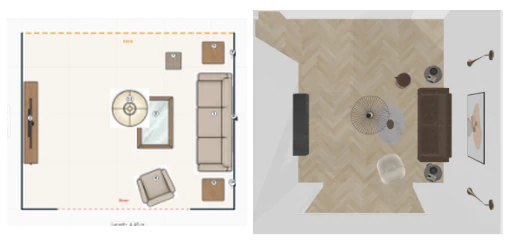
Learning an Interior Layout Policy in a Domain Specific Language Action Space
arXiv preprint, 2026
-
VL-Grasp: a 6-Dof Interactive Grasp Policy for Language-Oriented Objects in Cluttered Indoor Scenes
IROS, 2023
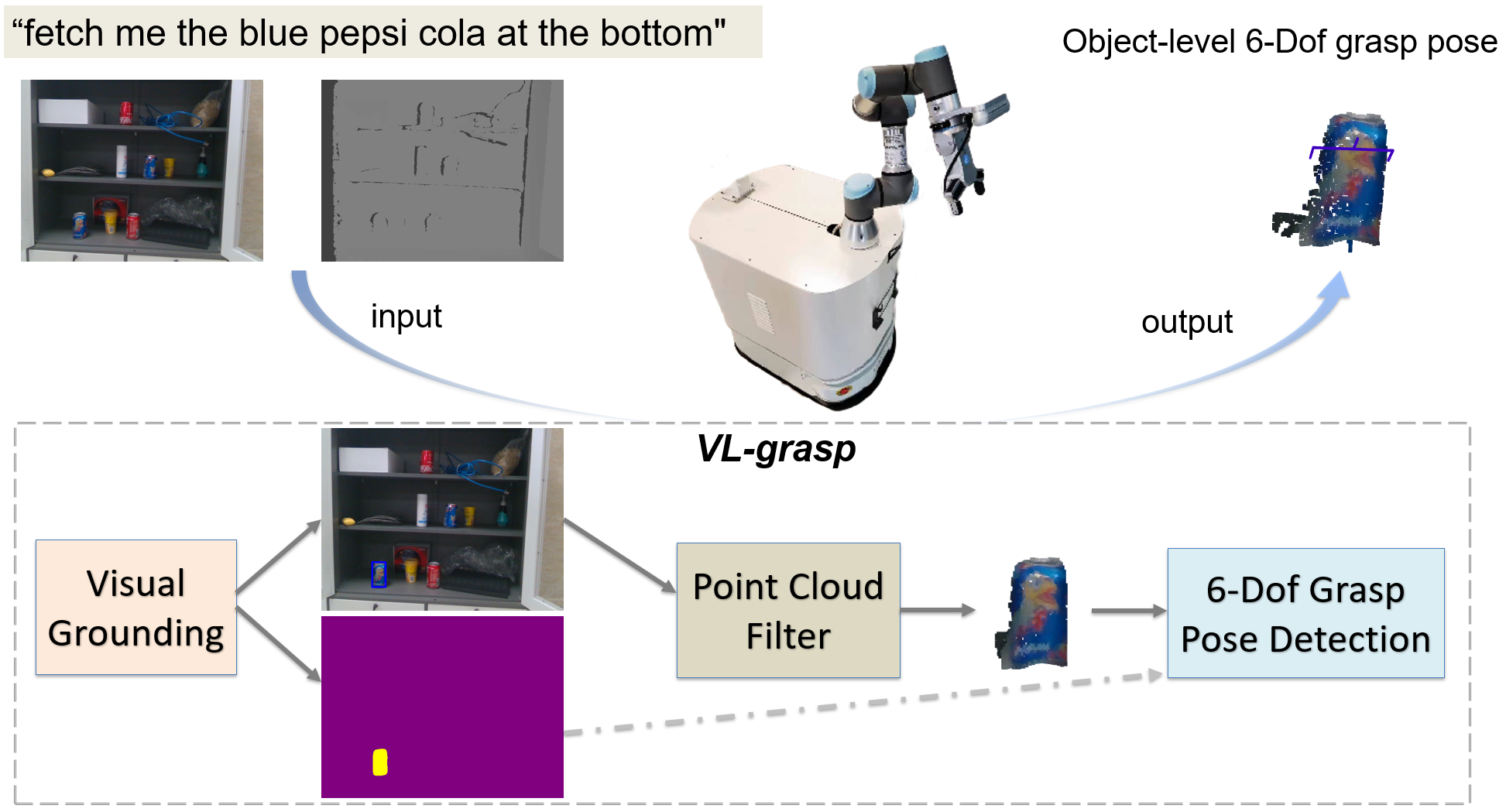
The VL-Grasp is a interactive grasp policy combined with visual grounding and 6-dof grasp pose detection tasks. The robot can adapt to various observation views and more diverse indoor scenes to grasp the target according to a human's language command by applying the VL-Grasp. Meanwhile, we build a new visual grounding dataset specially designed for the robot interaction grasp task, called RoboRefIt.
@misc{lu2023vlgrasp, title = {VL-Grasp: a 6-Dof Interactive Grasp Policy for Language-Oriented Objects in Cluttered Indoor Scenes}, author = { Lu, Yuhao and Fan, Yixuan and Deng, Beixing and Liu, Fangfu and Li, Yali and Wang, Shengjin }, year = {2023}, eprint = {2308.00640}, archivePrefix = {arXiv} } -
Hybrid Physical Metric For 6-DoF Grasp Pose Detection
ICRA, 2022
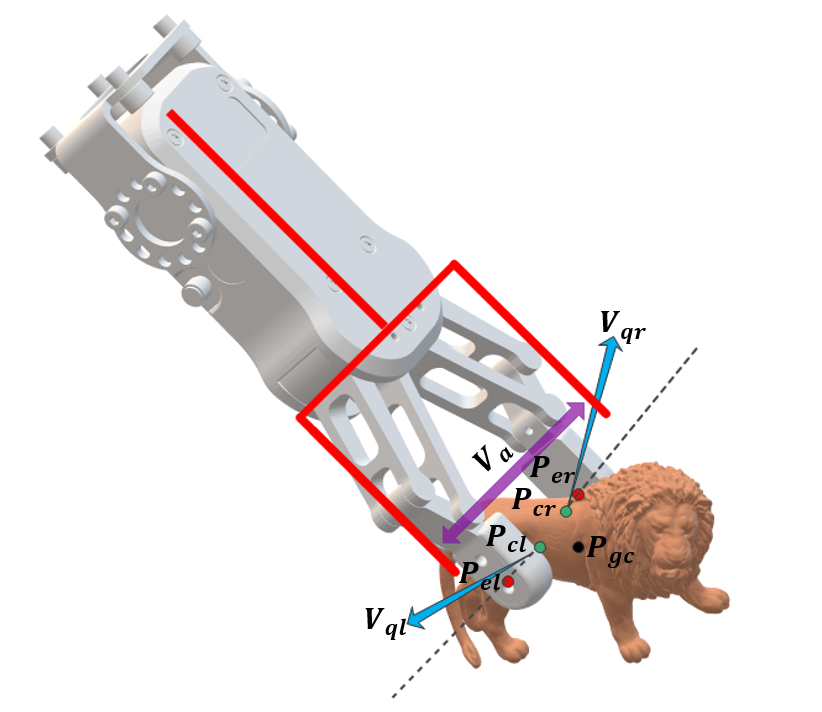
We proposed the hybrid physical metric to generate confidence labels for 6-dof grasp poses, and designed a transformer-based point cloud learning network, FGC_graspnet, to predict 6-dof grasp poses.
@misc{lu2022fgc,
  title = {Hybrid Physical Metric For 6-DoF Grasp Pose Detection},
  author = { Lu, Yuhao and Deng, Beixing and Wang, Zhengyu and Zhi, Peiyuan and Li, Yali and Wang, Shengjin },
  year = {2022},
  eprint = {2206.11141},
  archivePrefix = {arXiv}
}